

A source in the know said realistically two-three of the seven bullet train corridors could be included as a practical election promise.

With land acquisition completed and infrastructure work streamlined, India's bullet train dreams are slowly, but finally, inching closer to reality.

The revamped Special Economic Zone (SEZ) law is unlikely to see the light of the day before the upcoming Lok Sabha elections, two people aware of the matter said. The commerce department had sought the Union Cabinet's nod to bring amendments to the existing SEZ Act, 2005 late last year. The plan, thereafter, was to introduce the Bill in the winter session of Parliament. Cabinet's approval remains pending.

'The vision now is not just to look at national highways as a number of kilometres, but quality as well.'

Any government support or incentive to help exporters deal with high freight and insurance costs is unlikely.

Of the Rs 1.97 trillion that the government intends to spend on all 14 production-linked incentive (PLI) schemes, around Rs 41,000 crore remains unutilised as of now, according to a senior government official. This means that 80 per cent of the total allocated amount, or Rs 1.56 trillion, will be used to pay incentives to companies eligible to claim benefits over the next few years. The unutilised amount/savings result from undersubscription, lukewarm responses in the case of schemes such as textile, as well as a reduction in the allocation of schemes.

Prices may go up because of higher energy costs, caused by the rise in shipping charges, with commercial vessels taking a longer route to avoid the troubled Red Sea region, the finance ministry said on Monday. Iran-backed Houthi rebels of Yemen are repeatedly attacking ships in the Red Sea. While the global economy is grappling with challenges such as sticky inflation, sluggish growth, and mounting fiscal pressure, India's external sector could face "potential risks" due to the ongoing geopolitical tensions, according to the finance ministry's report on the review of the Indian economy.
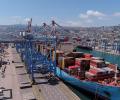
India's private and state government-owned ports (non-major ports) continued to grow faster than those owned by the Centre (major ports) through the first three quarters of 2023-24 (FY24), cargo handling data shows. At 604 million metric tonnes (mmt), cargo at major ports grew by 5 per cent between April and December, while non-major ports' cargo traffic growth was 11 per cent at 531 mmt. During December 2023, central government-owned ports in India handled cargo volumes of 69.9 mmt, a tepid year-on-year (Y-o-Y) growth of 0.7 per cent.
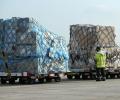
However, as of now, container availability has not been seen as an issue as adequate empties are available. The Red Sea strait is vital for 30 per cent of global container traffic and 12 per cent of global trade.

'We carry 6.5 billion passengers every year. We have crossed seven billion this year, and are targeting 10 billion by 2030.'

'Similar to the case of the digital payment system where the government created a public platform and others joined in, we are exploring a similar structure to create a PPP platform where the compute required for AI could be accessed by the small player.'

India's exports to Iran have been falling over the last one year, amid decline in rupee reserves of the West Asian economy. Going ahead, the possibility of augmenting exports to Iran may not be easy for India, considering the geopolitical tensions - Russia-Ukraine and Israel-Hamas conflicts - and the West Asian country's support for Russia and Hamas, people aware of the matter said. Exports to Iran saw a downward spiral since November last year.

'Due to the Israel-Hamas conflict, a faction operating in the Red Sea -- which is a typically safe area - has been firing projectiles arbitrarily.' 'Additionally, there have been two incidents involving Somali pirates, and one vessel has been hijacked.'

'Given that the situation is quickly escalating, such attacks will affect the flow of crude in the short term from West Asia' Subhayan Chakraborty and Dhruvaksh Saha report.

'If attacks escalate, there is a risk the Suez Canal may be closed.'
The Centre is unlikely to offer new direct tax incentives for units operating in special economic zones (SEZs) and may instead allow the grandfathering of previous exemptions that such units were entitled to, according to proposed amendments to the SEZ Act, 2005, people aware of the matter said. The amendments, proposed by the commerce department, will soon be considered by the Cabinet for approval. This represents a departure from the department's earlier plan to introduce these changes through the Development Enterprises and Services Hubs (DESH) Bill, 2023, which faced strong criticism from the ministry of finance.

33 per cent of all road accidents and 35 per cent of fatal accidents took place on national highways and expressways.

Commerce secretary Sunil Barthwal is set to attend a two-day meeting from October 23 at the World Trade Organization (WTO) headquarters in Geneva, that would focus on finding solutions and giving the 'necessary political push' for at least some crucial global trade issues. Next week's meeting comes ahead of the WTO's 13th ministerial conference (MC13), scheduled in Abu Dhabi in February 2024. It will see participation of senior government officials from all WTO member nations.
India's trade ties with Israel have only strengthened in the years after 2019. The total value of trade rose to $10.5 billion on a rolling four-quarter basis in June 2023 from $5.5 billion in the same month in 2019, shows a Business Standard analysis of data from the Centre for Monitoring Indian Economy (CMIE). A rolling four-quarter number provides a comparable figure across different time periods.
 © 2025 Rediff.com - Investor Information - Advertise with us - Disclaimer - Privacy Policy - Sitemap - Feedback - About us - Terms of use - Grievances